Home
Traditional AVAV++®WorldModel™
Technologies
QuickSilver®QuickSilver® RetrofitAlice®Alice® OnBoardAlice® AvatarsCheshireCat®TeaParty®Lory®LookingGlass™CaterPillar™WonderLens™PixelsEverywhere™AV++® AnalyticsPublished ArchitectureWho Are You?↳ Engage Early
More About Us
PortfolioOur StoryServicesInsightsIn the PressWonderlandNewsIP & PatentsContact
AV++® Technology
AV++® Backbone

QuickSilver®

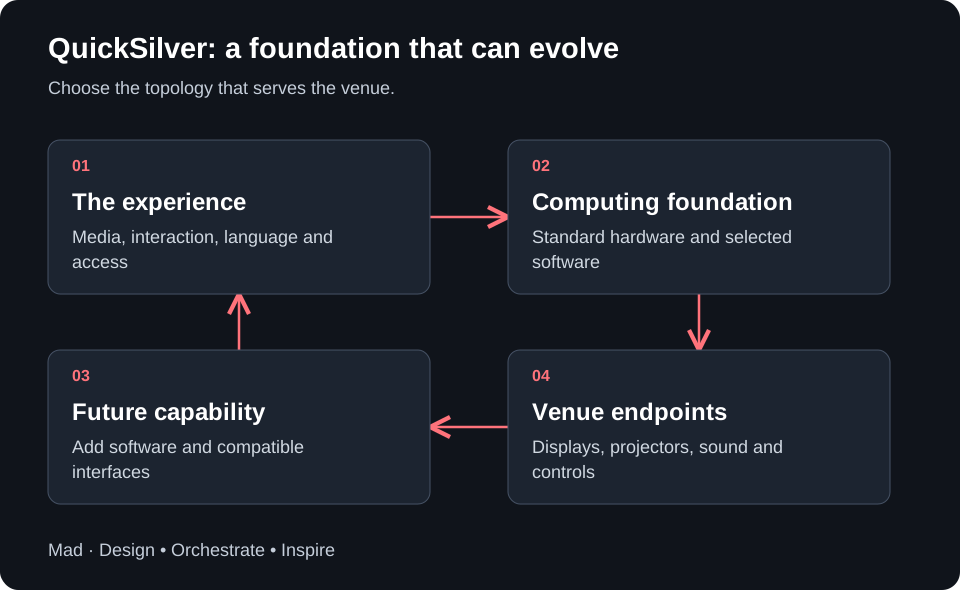
Non-proprietary venue compute in four deployment configurations

Architecture Continuum
QuickSilver®

QuickSilver® is the non-proprietary compute backbone of the Mad Systems AV++® architecture. It replaces proprietary single-purpose AV hardware with standard IT-based compute nodes and supports four deployment configurations - fully distributed, fully centralized, standard hybrid, and reverse hybrid - wired or wireless, depending on site conditions and project requirements. The right configuration is determined by the project, not imposed by the technology.

This does not replace professional AV discipline. It extends it. QuickSilver® preserves the predictable playback, routing, control, and show execution that owners expect from Traditional AV, while adding the compute layer needed for personalization, accessibility, analytics, multilingual delivery, and future intelligent behaviors. Every node is built from standard IT components, managed through a unified software layer. When a component needs replacement in 10 or 15 years, it is replaced with whatever is available - not a discontinued proprietary module from a single vendor.

Deployment flexibility

Four Deployment Configurations

QuickSilver® is not a fixed architecture. It supports four configurations depending on the venue's existing infrastructure, acoustic requirements, cabling constraints, and operational model. Wired and wireless deployment paths are available across all four. The configuration is determined by the project, not imposed by the technology.

Configuration 1
Fully distributed
Compute and audio both distributed - a QuickSilver® node placed at or near each exhibit or endpoint, handling both AV processing and local audio output. Reduces central rack requirements and cable runs.
Configuration 2
Fully centralized
QuickSilver® software and management running from a central rack or server room, with signal distribution out to endpoints through conventional AV infrastructure. Suits venues with strong central infrastructure already in place.
Configuration 3
Standard hybrid
Centralized compute handling content management and orchestration, with distributed endpoints receiving output. A common choice for larger venues where central management is preferred but full cable re-runs are impractical.
Configuration 4
Reverse hybrid
Compute distributed at the edge - a node per exhibit or zone - but audio returned to a centralized audio system. This suits venues where acoustic design, DSP management, or speaker infrastructure is centralized while visual and interactive computing is distributed.

All four configurations support wired or wireless connectivity. Configuration selection is part of the pre-specification engagement process and is determined by site survey, acoustic requirements, infrastructure assessment, and operational model.

Why it matters

What Changes with Non-Proprietary Compute

Traditional proprietary AV hardware is purpose-built and single-function: one box does playback, another switching, another control. When any is discontinued, the whole system becomes difficult to maintain. QuickSilver® replaces this stack with standard, general-purpose compute nodes - each capable of running multiple functions in software, in whatever configuration the project requires. Fewer single-purpose boxes. No vendor EOL events that strand a system in ten years.

For owners and operators
Lower lifecycle cost. Remote support that resolves most issues without a site visit. A system that can be serviced by any qualified technician, not just one vendor. No proprietary service contracts required to keep exhibits running.
For architects and planners
Smaller node footprint, standard IT-grade power and data requirements, and no specialized equipment rooms. Conduit and power strategy is simpler. Infrastructure documentation follows standard IT conventions.
For integrators
Standard hardware, standard networking, standard tools. No proprietary programming environments. Systems that can be commissioned, tested, and documented using normal AV and IT workflows.
For public institutions
Procurement that is not locked to a single supplier. Technology that can be maintained by public-sector IT staff or any qualified third party. Infrastructure that does not create long-term dependency on a private vendor's survival.
Capabilities

What QuickSilver® Provides

Non-Proprietary Hardware

Built entirely from standard IT compute nodes and off-the-shelf components. No vendor lock-in.

Venue-Scale Architecture

Manages hundreds of endpoints across an entire campus - wired or wireless.

Remote Management

Full remote monitoring, diagnostics, and management. Most issues resolved without a site visit.

Field-Serviceable

Any technician can service the hardware. Standard components, standard tools, standard procedures.

15–20+ Year Lifecycle

Designed for 15–20+ year operation. Components are standard and replaceable individually.

Enabling Unified Ecosystem

QuickSilver® enables all AV++® technologies - Alice®, CheshireCat®, TeaParty®, Lory®, and more - now or in the future. Add recognition, personalization, and governed AI capabilities when the project is ready.

Architecture position

Role inside the Mad Systems stack

Tier 1
Traditional AV
QuickSilver® delivers the same baseline AV capabilities as Traditional AV: playback, routing, switching, show control, and exhibit operation. Traditional AV work does not require QuickSilver® - but QuickSilver® is fully capable of it.
Tier 2 - QuickSilver® lives here
AV++® Architecture
QuickSilver® is the backbone of AV++®. It provides the distributed compute layer on which Alice®, CheshireCat®, Lory®, TeaParty®, CaterPillar™, and other technologies run. No QuickSilver®, no AV++® stack.
Tier 3
WorldModel™
At destination scale, QuickSilver® nodes become the distributed infrastructure that WorldModel™ governs - providing the physical compute substrate for constitutional AI operation across zones, buildings, and sites.
Patented
QuickSilver® is covered by issued US and international patents on non-proprietary AV compute architecture and personalized media delivery methods. View the patent portfolio →

QuickSilver® is available for direct project delivery, licensed deployment, and partnership integration. Early engagement is the right starting point.

Engage Early → Start a Conversation See It at Wonderland