QuickSilver® underneath
Standard computer hardware provides the computing foundation for playback, interaction and coordinated surface behavior, with replaceable components and practical upgrade options.
ExplorePIXELSEVERYWHERE™
PixelsEverywhere™ turns display and projection surfaces into programmable interpretation. The visual story can change with the language, the content and the needs of the experience.
THE FIRST PIXELSEVERYWHERE VISITOR CENTER
Mad first implemented PixelsEverywhere at the Water Replenishment District’s Albert Robles Center in Pico Rivera, California. In the visitor center, the interpretive graphics are digital throughout. The complete interpretive experience changes between English and Spanish.
We call that 100% language dignity. Every supported language carries the full story across the visual content, narration and interactions. Visitors receive a complete experience in their language.
Additional languages can achieve the same standard when their complete content sets have been authored, reviewed and added. The infrastructure gives those languages a place throughout the visitor center.
Read the full ARC case study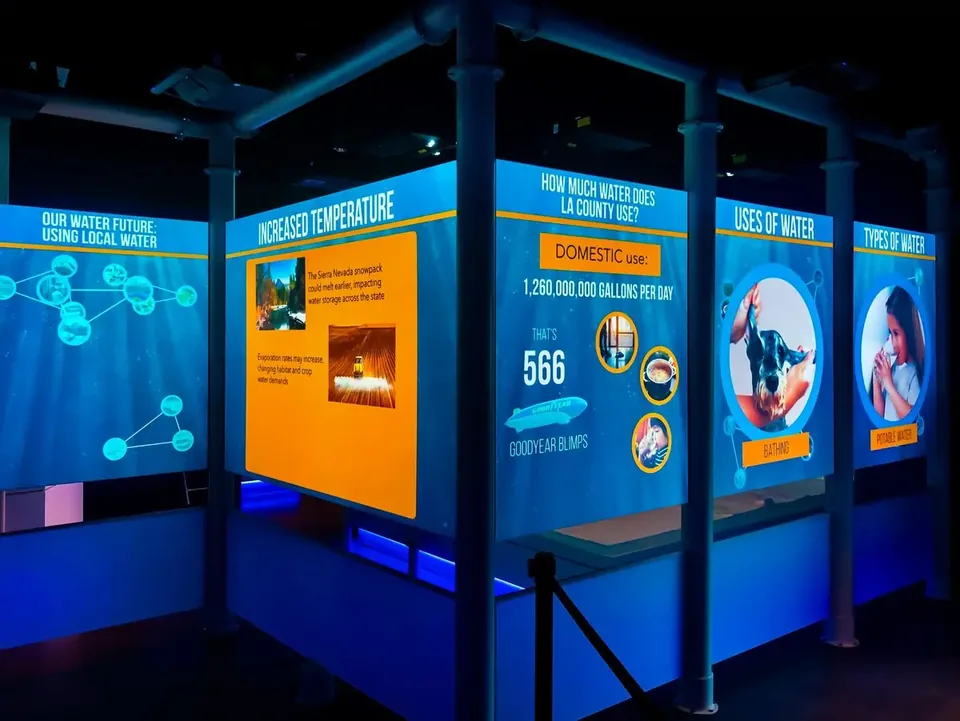
DIGITAL INTERPRETATION THROUGHOUT
Displays, projection, LED surfaces, interactive tables and architectural elements can carry coordinated visual content. Each surface or group of surfaces becomes part of an addressable, programmable environment, with the content, timing and behavior determined by the experience design.
That lets an exhibition change its interpretation as the subject, audience or language program develops. A client can refresh authored content without replacing a room full of printed interpretive panels. It also creates opportunities to coordinate the visual story with personal audio, interactions and show sequences.
The design still needs to account for legibility, sight lines, contrast, lighting, content composition and the physical properties of each surface. Digital interpretation becomes useful when those details serve the people in the room.
PART OF THE AV++® FAMILY
Standard computer hardware provides the computing foundation for playback, interaction and coordinated surface behavior, with replaceable components and practical upgrade options.
ExploreWhere included, Alice® selects from venue-controlled content, while Lory® provides personal media delivery. The visual and personal experiences can share the same language and narrative.
ExploreTeaParty® coordinates the show. Mad Intelligence™ provides the wider architecture for retaining requirements, verifying outcomes and directing permitted responses as an installation changes.
ExploreThe capabilities in the wider family are specified separately for each project. ARC’s deployed story is QuickSilver and PixelsEverywhere. Additional technologies and future language sets are upgrade possibilities to evaluate.
FOR THE LIFE OF THE STORY
For designers, PixelsEverywhere makes language and content flexibility a creative material. A label, a map, a diagram or a room-scale visual can be authored as part of a complete language experience.
For operators, the important questions become practical: who approves each content set, how an update is checked, when it is deployed, and how the venue knows the intended version is showing.
For owners, it creates room to grow. New research, an updated education program or another community language can be incorporated into a system designed for change.
Mad helps plan the display infrastructure, content workflow and operating requirements together, so that the complete experience remains coherent.
LET’S BUILD WHAT COMES NEXT
Let’s plan the surfaces, content and infrastructure that let every supported language tell the whole story.
Start a conversation