Hatter™ Beyond DSP

New from MadPart of the AV++® family

AUDIO DSP + ACOUSTIC EXPERIENCE

Patent pending

Mad Hatter™
A DSP for what comes next.

Mad Hatter™ is a software-defined digital signal processor, or DSP, and an acoustic experience engine. It combines the processing and control audio professionals expect with soundscape authoring, Mad Presence™ head-tracked loudspeaker listening and the continuing engineering of Mad Intelligence™.

With Mad Presence, two loudspeakers per listener position bring an authored scene into the space around the listener. Build the signal path, shape the experience and keep its purpose in view as the room, audience and equipment change.

HATTER TODAY

Working software: DSP processing and authoring, Mad Presence™ head-tracked loudspeaker listening on Mac, headphone and earbud listening, timing and network audio.

Being qualified: consumer-device measurements and the acoustic performance of each proposed venue configuration.

In development: Mad Nulling™, dedicated CTCS™ (The Camera That Cannot See™) tracking nodes, participating-device indoor location, personal delivery and newer guidance combinations. Plan your configuration.

THE DSP FUNDAMENTALS

Everything you expect from a DSP.
Built for a much bigger brief.

Hatter includes the signal processing, routing, mixing, programming and control that audio professionals expect. Those functions are the foundation of the system.

  • Routing and mixingInputs, outputs, matrix mixing, gains and per-channel processing.
  • EQ, filters and delayEqualization, filtering, alignment delays, crossovers and convolution.
  • Dynamics and protectionDynamics processing, limiting and protection matched to the system.
  • Playback and integrationMedia, network audio, named controls and supported external interfaces.
  • Lua and PythonProgrammable control, events, timers and cues within Hatter's timing architecture.
  • Qualified processorsAdditional processing, including echo cancellation, feedback control, automixing and noise reduction, through suitable hosted processors.

That familiar checklist reflects the DSP brief inherited from earlier generations. Today's experiences ask more: sound that belongs to moving objects, responds to a listener, shares a room with other stories and continues to meet the designer's intent as conditions change. Hatter brings those responsibilities into the DSP's world.

See what Hatter adds

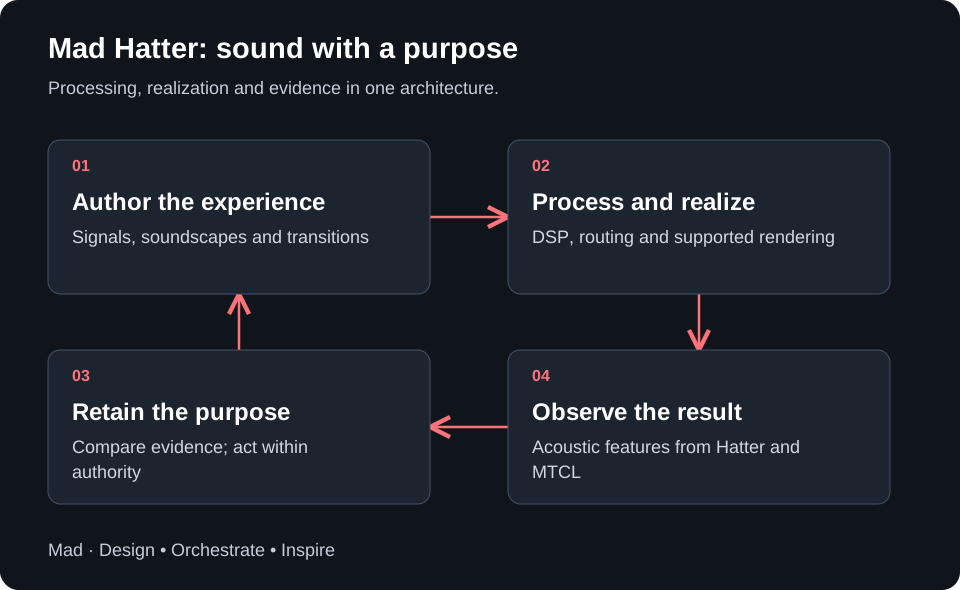
Mad Hatter: sound with a purpose
Hatter connects its digital signal processing foundation with soundscape authoring, listening and acoustic evidence. Dedicated sensing and wider adaptive combinations continue in development.
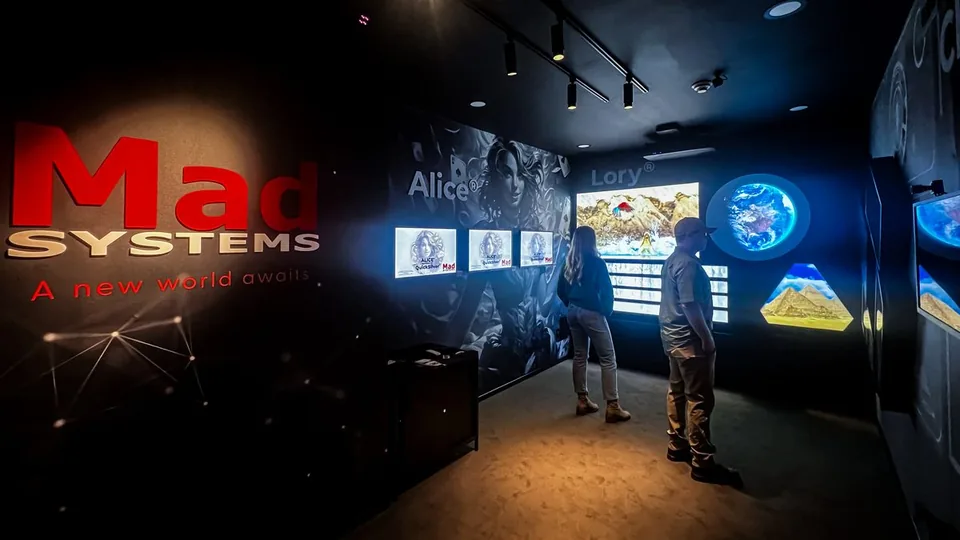
Mad’s Wonderland demonstration room with projection, displays and seating
Mad’s Wonderland demonstration room in an earlier configuration. Arrange a visit to discuss and listen to the Hatter capabilities relevant to your project.

NEW FROM MAD · THE AV++® FAMILY

Mad’s first excursion beyond the traditional DSP brief.

Hatter is a DSP. Processing, routing, mixing and programmable control remain its foundation. Its wider brief brings soundscape composition, Mad Presence™ spatial listening, listener context, acoustic measurement and continuing engineering into the same environment.

Part of AV++®.

Hatter belongs within Mad’s AV++ technology family, alongside the computing, media, interaction and operating capabilities that realize an experience. Its role is the sound: what it should do, where people should hear it and how the installation delivers it.

Connected to Mad Intelligence™.

Mad Intelligence keeps the purpose of the wider environment active. WorldModel supplies shared context and governance. Hatter contributes acoustic realization and evidence, and can also serve as a focused audio platform in its own right.

THE EXPERIENCE IS THE REQUIREMENT

Make sound do what the exhibit intends.

The aim is simple: make sound do what the exhibit intends, at the places where people actually stand, and check the result. A voice should belong to the character. A story should remain clear when a school group arrives. A soundscape should evolve naturally. The experience should keep its purpose as the room, equipment and audience change.

Hatter connects those creative intentions to the actual installation. It is designed to correct what available resources can correct, and explain what needs an engineer's attention. As part of the AV++® technology family, Hatter connects acoustic delivery and evidence to Mad Intelligence™. It can also serve as a focused audio platform in its own right.

TWO VIEWS OF ONE EXPERIENCE

Start with your part of the brief.

Explore the creative possibilities and the responsibilities of the working room.

01 / CREATIVE INTENT

Begin with the moment you want to create.

A voice that seems to come from a sculpture. A creature that moves through a forest around the audience. A clear explanation in a busy gallery. Neighboring exhibits that coexist without competing for attention. A personal version of the story for someone who needs a different language or a different way to receive it.

Hatter starts with that brief. The design records where a sound belongs, how it behaves, who it is for and what a successful result means. The engineering can then assess the room and available resources against the intended experience.

02 / LIVING SOUNDSCAPES

Compose an environment that keeps changing.

A forest is more than a recording on repeat. Hatter's soundscape tools combine continuous ambience, individual events, moving sources and authored variation. You can shape how often a sound appears, how it moves, which elements belong together and how one environment becomes another.

Transitions between different soundscapes can be authored. Transitions have their own character. Daytime activity can gradually diminish while the evening scene emerges. An event can finish naturally as the next begins. Narration and interaction can take priority without stripping the environment of its identity.

03 / SOUND IN SPACE

Give sound a place in the story.

Hatter supports ordinary playback as well as multichannel and spatial scenes. Voices, music, effects, atmosphere and low-frequency experiences can take different roles. A source can belong to an object, follow a path or respond to an event, with its realization assessed against the loudspeakers and acoustics of the installation. Repetition, variation, density and transitions between different soundscapes can be authored.

The same scene can be developed through different listening arrangements, including suitable headphones or a compact loudspeaker pair. This lets creative work continue before the full venue exists and while the team is away from site.

04 / DESIGN THAT LASTS

Keep the design when the equipment changes.

Creative intent should outlast an amplifier model or a particular computer. Hatter separates the authored experience from the resources used to realize it. Replacement equipment and revised layouts can be assessed against the same requirements, preserving the purpose of the design while making any changed capability explicit.

Physics remains part of the brief. Coverage, intelligibility, localization and separation depend on geometry, equipment and the room. Hatter's architecture makes those limits part of the design conversation and the operating record.

01 / THE CHANGING ROOM

Keep the story understandable.

A room changes throughout the day. Visitors alter its acoustic behavior. Doors and partitions move. Background noise rises and falls. Hatter's verification architecture connects measurements to the requirements for the listening areas, so the relevant question remains whether the presentation is doing its job.

Where the installation provides the necessary sensing and control, it can adjust within agreed limits and check the result. When the available equipment cannot restore the objective, the remaining problem is identified for the operator.

02 / THE PEOPLE PRESENT

Give each visitor an appropriate way in.

A shared experience can offer different languages, explanations and accessibility support. Hatter's delivery architecture accommodates a common presentation alongside personal audio and companion content, including delivery through Lory® where appropriate.

Hatter's developing indoor-navigation work uses participating visitors' devices and the installation's sound to establish position for guidance, interaction and personal media. It is being developed with location confidence and the accuracy needed for each decision in view. Personalization follows declared choices and permissions.

03 / ACCOUNTABLE OPERATION

Make daily operation clear.

Schedules, cues, live inputs, recorded or synthesized announcements and operator controls belong to the same operating picture. Priority messages can take precedence under the venue's control design. A master mute has a defined, enforced output state. Lost timing references and unavailable resources are reported explicitly.

Operators need an understandable account of what changed, what the system corrected and what still needs attention. Hatter's operating record is designed to connect each action with the result it was meant to achieve, with a clear view through the Deck™ where integrated.

04 / PURPOSEFUL MEASUREMENT

Measure the room while respecting its visitors.

MTCL™, The Microphone That Cannot Listen™, provides purpose-limited acoustic measurements without exporting an audio stream of visitors' conversations. CTCS™, The Camera That Cannot See™, extends that approach toward head position and orientation without identity recognition.

Hatter's local head tracking already operates. MTCL supplies acoustic measurements; the developing CTCS node supplies listener pose. Each collects only what its task requires.

IMMERSION AND EXHIBIT COEXISTENCE

Immersive sound.
Room for each exhibit.

Mad Presence™

Mad Presence™ uses two loudspeakers per listener position and head tracking to keep an authored spatial scene oriented as the listener turns and moves within the configured listening region.

Head-tracked loudspeaker rendering already runs on the Mac, alongside supported headphone and earbud listening. Each venue arrangement is configured and tested for its own listening positions and acoustic result.

Explore Mad Presence™

Mad Nulling™

Mad Nulling™ is our ongoing work to reduce the effect of one exhibit's sound on adjacent exhibits. The aim is to let neighboring stories coexist while preserving what each audience should hear.

The listening positions, exhibit layout and room acoustics shape the solution. Measurements establish the reduction each arrangement can achieve while preserving the experience on both sides.

Explore Mad Nulling™ development

THE EXPERIENCE, VERIFIED

Know that the sound reached the room.

Hatter contributes the audio checks to TruCheck™, Mad's verification capability. MTCL™, The Microphone That Cannot Listen™, supplies local acoustic measurements to help identify a failed loudspeaker, a changed path or a result that has drifted from the design, without exporting a stream of conversations.

CheshireTracks™ is the developing camera capability for occupancy heat maps and visual checks of displays and projectors. TruView™ gives the operator a remote visual view. These distinct roles connect sound, visual output and operating evidence to the verify step of Mad Intelligence™.

Explore the verification story
TECHNICAL DETAIL

A DSP with the whole experience in view.

Open the engineering detailClose this sectionLook for the red circuit symbol for engineering detail.

WHAT MAKES HATTER DIFFERENT

Hatter brings processing, creative authoring, listener context and acoustic evidence into one architecture. The result is a far wider role for the DSP, from the first sound brief through the continuing life of the installation.

The familiar DSP foundation and the wider capabilities Hatter connects to it
Standard DSP foundationWhat Hatter adds
Process and route audioRetain what the sound must achieve, then relate the processing to the actual equipment, listening positions and acoustic result.
Play and mix sourcesAuthor living soundscapes with variation, density, movement, event behavior and transitions. Keep the scene meaningful beyond an output number.
Feed the listening systemConnect the authored scene to listener position and orientation through Mad Presence™, including the working head-tracked loudspeaker experience and supported headphone and earbud listening.
Program controls and cuesConnect Lua, Python and JavaScript programs to named controls, events and engine-executed cues, with the authored scene, timing and venue permissions in the same operating picture.
Set up zones and alternate programsConnect delivery with language, access needs and the people present. Mad Nulling™ extends the work toward reducing interference between neighboring exhibits, with development and physical testing ongoing.
Meter, monitor and commissionRelate acoustic observations to the retained design requirements, qualify the evidence, and support continuing correction within agreed limits through Mad Intelligence™.
Store settings and maintain the systemPreserve the intended experience as equipment, layouts and conditions change. Keep the result of each change, and any unresolved shortfall, in view.

Hatter's distinctive capability is this connection between the authored experience, the resources that deliver it and the evidence used to check it. The complete capability guide explains the processing foundation, working demonstrations and newer capabilities now being developed.

Explore the complete capability guide

TECHNICAL DETAIL

Specify Hatter for your system.

Open the engineering detailClose this section

CONFIGURATION AND CONNECTIONS

Choose the engine and connections to match the design. The channel counts below describe engine inputs and outputs; physical connectors depend on the installed interfaces.

Documented Hatter configuration and integration options
SpecifyOptions and role
Engine configuration64 × 64, 128 × 128 or 256 × 256 audio channels.
Computing platformLinux and Mac engines. The selected computer and processing design determine capacity.
Network audio and timeNative AES67 audio over an IP network, with PTP (Precision Time Protocol) network timing. Dante integration is available through appropriately licensed interfaces.
ProgrammingLua, Python and JavaScript for controls, events, timers and cues, with sound actions scheduled by the audio engine.
Control interfacesA text protocol over TCP, structured JSON messages and OSC (Open Sound Control), with named controls and event subscriptions.
Equipment integrationModbus for device communication; PJLink for projectors; DMX over Art-Net for lighting; MQTT messaging; GPIO for general-purpose inputs and outputs; KNX and BACnet for building systems.
Show control and timecodeTeaParty®, MIDI, MIDI Show Control and RTP-MIDI network transport. Linear timecode (LTC), MIDI timecode (MTC) and Art-Net timecode connect supported timing sources.
Hosted processorsAudio Units and VST3 on Mac; CLAP, VST3 and LV2 on Linux. The host, processor license and processing load define the available configuration.
Mad Presence™Two loudspeakers per listener position, with head tracking. The working Mac implementation also supports headphone and earbud listening; each installed arrangement establishes its own listening region.
Acoustic measurementMTCL™, The Microphone That Cannot Listen™, processes sound locally and supplies measurement features under a declared data budget, without exporting an audio stream.

The project specification records the physical interfaces, sample rate, end-to-end latency, processing and plugin load, network conditions and required acoustic result for the selected configuration.

TECHNICAL DETAIL

The tools to build the signal path.
The scope to build much more.

Open the engineering detailClose this section

BLOCKS AND CONNECTED CAPABILITIES

Hatter brings processing blocks, media sources, creative tools and operating functions into the same system. Start with the DSP tools your design needs, then connect them to the experience you want to create.

The selected Hatter build, interfaces and qualified processors define the exact configuration. The directory includes the processing foundation, wider operating capabilities and the development directions identified below.

01 / PROCESSING AND ROUTING

The DSP foundation.

  • Gain and level: named controls, timed ramps, fades and connection gains.
  • EQ and filters: per-channel treatment, including parametric equalization.
  • Delay and alignment: timing within the signal path and the listening design.
  • Dynamics and limiting: level control and protection within the permitted operating range.
  • Crossovers and driver protection: processing related to the loudspeaker's capabilities.
  • Convolution: filter processing sized to the available computing resources.
  • Mixers and matrices: explicit signal paths, channel maps and controllable crosspoints.

02 / SOURCES AND MEDIA

Bring the material together.

  • Audio inputs and outputs: supported microphone, line, digital and device interfaces.
  • Media players: playback, looping and declared channel interpretation.
  • Playlists and sequences: ordered content, transitions and triggered progression.
  • Recorders: explicitly authorized capture for the venue's media workflow.
  • Tone and noise generators: test signals and authored sound sources.
  • Network-audio transmitters and receivers: AES67 streams, channel binding and visible stream state.
  • External sources: supported telephone inputs and licensed business-music services.

03 / CREATIVE AND SPATIAL TOOLS

Give sound behavior and place.

  • Soundscape containers: continuous beds, events, groups and independently routed stems.
  • Selection and variation: weighted, random, shuffle and sequential choices with controlled repetition.
  • Density and polyphony: shape activity, overlap and transitions while sounds finish naturally.
  • Spatial scenes: positioned sources, paths and declared multichannel or ambisonic interpretation.
  • Monitor profiles: listen to the same scene through suitable stereo, binaural and venue-output views.
  • Speech and announcements: recorded, live and synthesized material with declared priority and ducking.
  • Mad Presence™: head-tracked spatial listening through a loudspeaker pair, with supported headphone and earbud listening too.

04 / PROGRAMMING AND TIME

Make the show respond.

  • Lua, Python and JavaScript: programmable behavior under a shared control and permission model.
  • Named controls and events: read state, subscribe to changes, run timers and request cues.
  • Show-control integration: TeaParty®, OSC, MIDI, MIDI Show Control and RTP-MIDI.
  • Timecode: follow and generate LTC or MTC, with supported Art-Net timecode paths.
  • Named clocks and cues: scheduled sound execution on the audio clock.
  • Schedules: civil and solar time, recurring events, exceptions and local calendar execution.
  • Rehearsal: manual transport, scrub, jog, jump and a controlled return to normal timing.

05 / PROCESSORS AND INTERFACES

Connect the resources the job needs.

  • Qualified plugin inserts: third-party audio processing with measured latency, load and failure behavior.
  • Plugin formats: Audio Units, CLAP, VST3 and LV2 through the appropriate supported host and licensing.
  • Optional microphone processing: echo cancellation, feedback suppression, automixing and noise reduction through suitable processors.
  • Physical I/O: enrolled sensors, triggers, contacts, digital and analog interfaces, and declared output states.
  • Equipment protocols: integration paths for Modbus, PJLink, MQTT, GPIO, KNX, BACnet and DMX over Art-Net, as supported by the installation.
  • Network-audio options: native AES67 and appropriately licensed Dante integration.

06 / OPERATION AND RESILIENCE

Keep the system understandable.

  • Priorities and master mute: controlled announcement precedence, ducking and enforced digital output state.
  • Snapshots and packages: stored scenes, reusable blocks, templates and macros.
  • Controlled changes: visible proposals, scoped permissions, versioned updates and trials with restoration.
  • Capacity: measured processing cost, reserved headroom and explicit overload behavior.
  • Recovery: restart, replacement and qualified redundancy with the destination checked again.
  • Media and operating records: asset provenance, rights, event history, diagnostics and reproducible review.
  • Trustworthy network operation: clock condition, stream readiness, running state and missing dependencies.

07 / MEASUREMENT AND INTELLIGENCE

Connect the setting to the result.

  • Retained requirements: intelligibility, coverage, localization, level, comfort and neighboring-exhibit conditions.
  • Device profiles: equipment capabilities, protection limits and comparison with the installed behavior.
  • Continuing supervision: loudspeaker paths, acoustic observations, equipment telemetry and sensor health.
  • MTCL™: purpose-limited acoustic measurements through The Microphone That Cannot Listen™.
  • Measured models: prediction, virtual listening, diagnosis and proposed changes, with the quality of the evidence stated.
  • Continuing engineering: permitted correction and a clear account of what still needs physical work, within Mad Intelligence™.

08 / CAPABILITIES IN DEVELOPMENT

Extend what the experience can do.

  • Mad Nulling™: reduce the effect of one exhibit's sound on adjacent exhibits.
  • CTCS™: dedicated Camera That Cannot See™ nodes that provide pose without identity recognition.
  • Participating visitor devices: acoustic measurement and indoor location for navigation, interaction and personal media.
  • Personal delivery: connect location, chosen preferences and synchronized accessible content.
  • Guidance: extend CaterPillar™ through suitable venue loudspeakers and personal endpoints.
  • Allocation and handoff: choose and transition between resources as people and conditions change.
  • Measurement-led optimization: compare arrangements, environmental effects and possible physical improvements.

These extensions build on existing software and specified architecture. Their complete installation behavior is being developed and physically verified.

TECHNICAL DETAIL

Understand the experience.
Respect the people in it.

Open the engineering detailClose this section

PRIVACY BY DESIGN

A system may need to know whether a loudspeaker is working, where a listener is standing or which language a visitor has chosen. Each question calls for specific information. Privacy begins with limiting what is collected, retained and shared to that purpose.

ACOUSTIC MEASUREMENT

MTCL™

The Microphone That Cannot Listen™

A sound system needs to know whether its sound reached the room. MTCL gives Hatter acoustic measurements without providing a stream of visitors' conversations.

It processes sound locally and passes only the limited measurements needed to check the installation, such as level, the presence of a known signal and its arrival time. Its privacy build excludes an audio-stream output. A declared data budget and monitoring make the information leaving the node accountable.

The purpose is practical: help detect a failed loudspeaker, a changed acoustic path or a departure from the design while respecting the people enjoying the experience.

POSITION AND ORIENTATION

CTCS™

The Camera That Cannot See™

Mad Presence needs to know where a listener is and which way their head faces. That job does not require knowing who the person is.

CTCS is our developing camera-node architecture for that purpose. It processes images on the device and is designed to pass only position, orientation and tracking quality, with no picture stored or sent and no identity recognition.

Local head tracking already operates in Hatter. The dedicated CTCS node extends that approach toward installation use.

CHOICE, RECOGNITION AND LOCAL INTELLIGENCE

Remember what a visitor wants to share.

CheshireCat® has a separate, optional role: connect a visitor who chooses recognition to their experience and preferences. A visit can use temporary settings, while a consenting member can choose to retain preferences for a return visit or across participating venues. The purpose, duration and permitted sharing of that information belong to the venue's design.

CTCS supplies listener pose. CheshireTracks™ has the separate role of venue-scale occupancy heat maps and visual output checks. Both are designed without identity recognition; optional CheshireCat recognition follows the visitor's separate choice.

Mad is also demonstrating Alice® with a local language model. This advances the transition toward intelligence operated within the venue, or an explicitly authorized group of venues, so important visitor and venue data can remain within that environment. The selected content, speech and AI services must support that local deployment.

ONE ARCHITECTURE

AV++® sound, guided by Mad Intelligence™.

Mad Intelligence retains the designer's intent across the physical environment. WorldModel™ supplies the relevant context, relationships and authority. Within AV++®, QuickSilver® provides distributed media and computing, with TeaParty® connecting control. Hatter applies the continuing loop of intent, realization, verification and correction to sound.

Hatter therefore contributes both to delivering an experience and to checking its acoustic result. The wider system can coordinate that result with imagery, lighting, interaction, motion and other qualified resources.

EXPERIENCE IT AT WONDERLAND

Bring us a sound moment from your brief.

Tell us what the visitor should hear, where it should happen and what must coexist around it. At Wonderland, Mad's demonstration environment, we can use that requirement to frame a practical discussion of the available capabilities and the next useful test.

Ask to experience Mad Presence™. The working Mac demonstration lets you explore head-tracked spatial sound through a loudspeaker pair, as well as supported headphones or earbuds. Then bring your story, listening positions and neighboring conditions into the discussion.

LET’S BUILD WHAT COMES NEXT

What should your audience hear?

Bring the story, the space and the difficult part of the brief. We will connect the intended experience to a practical next step.

Arrange a Hatter discussion