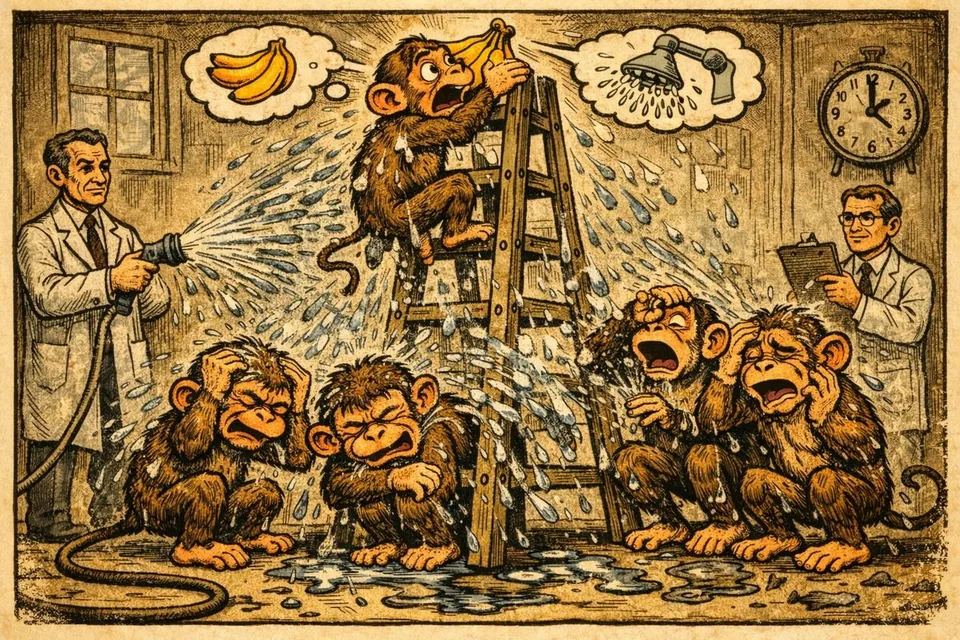
There is a well-known parable about five monkeys. It is not really about monkeys. It is about what happens when a group keeps enforcing a rule long after the original reason for that rule has disappeared. In AV and Location Based Entertainment, that pattern shows up all the time.
Five monkeys are placed in a habitat with a ladder in the middle. At the top of the ladder hangs a bunch of bananas. Naturally, one of the monkeys climbs the ladder to grab the bananas. When it does, the researchers spray the rest of the monkeys with cold water. After a few attempts, the monkeys quickly learn the connection.
Banana = Cold Shower.
Before long, whenever a monkey even tries to climb the ladder, the other monkeys pull it down and beat it up to stop it.
- One original monkey is replaced. The new monkey tries to climb. The others attack. It learns not to climb - even though it has never been sprayed.
- Another original is replaced. Same result. The new monkey learns the rule.
- This continues until all five originals are gone.
None of them have ever been sprayed. None of them know why.
But none of them will climb the ladder. And if a new monkey tries, the group will still beat it up.
Why?
Because that is just the way things are done.
That is how large parts of this industry still operate.
Too many teams inherit technical assumptions from the last project, then production assumptions from the last technical stack, then budget assumptions from the last production model. Eventually those assumptions stop looking like choices and start being treated like physics.
Much of that behavior comes from designing around proprietary black box hardware. Once a system is built on closed, single-purpose devices, everything downstream begins to conform to their limitations. Workflows. Support models. Spare strategies. Upgrade paths. Before long, entire organizations are protecting the ladder - without asking whether the ladder still needs to be there.
We chose a different starting point.
We built a system that bases AV hardware on non-proprietary compute node hardware rather than on closed black box endpoints. That decision changed the problem space.
- Hyper-personalization became possible - behavior no longer had to be locked inside fixed-function hardware. Experiences could become adaptive, contextual, and individualized in software.
- Spares were minimized - standardized around a smaller family of node types instead of a growing inventory of specialized proprietary devices.
- Upgrades became easier - increasing capability often means increasing compute available to a node, not replacing entire subsystems.
We did not set out to defend the old ladder. We set out to remove the reasons people thought they could not climb it.