Hatter™ Beyond DSP

Patent pending

THE MAD HATTER CAPABILITIES AND ARCHITECTURE

A complete DSP.
A much wider capability.

Mad Hatter™ brings the familiar digital signal processor (DSP) signal path into a complete acoustic experience architecture. Mad Presence™ adds head-tracked spatial listening through two loudspeakers per listener position. Processing, programming, creative authoring and continuing verification share the same purpose: the sound the designer intended.

DSP foundations. Lua and Python. Spatial sound. Head tracking. Continuing engineering.

HATTER TODAY

Working software: DSP processing and authoring, Mad Presence™ head-tracked loudspeaker listening on Mac, headphone and earbud listening, timing and network audio.

Being qualified: consumer-device measurements and the acoustic performance of each proposed venue configuration.

In development: Mad Nulling™, dedicated CTCS™ (The Camera That Cannot See™) tracking nodes, participating-device indoor location, personal delivery and newer guidance combinations. Plan your configuration.

Explore Hatter from the signal path through creative authoring, spatial listening, verification and daily operation. Start with the configuration options, or open the subject that matters to your design.

TECHNICAL DETAIL

Specify Hatter for your system.

Open the engineering detailClose this sectionLook for the red circuit symbol for engineering detail.

CONFIGURATION AND CONNECTIONS

Choose the engine and connections to match the design. The channel counts below describe engine inputs and outputs; physical connectors depend on the installed interfaces.

Documented Hatter configuration and integration options
SpecifyOptions and role
Engine configuration64 × 64, 128 × 128 or 256 × 256 audio channels.
Computing platformLinux and Mac engines. The selected computer and processing design determine capacity.
Network audio and timeNative AES67 audio over an IP network, with PTP (Precision Time Protocol) network timing. Dante integration is available through appropriately licensed interfaces.
ProgrammingLua, Python and JavaScript for controls, events, timers and cues, with sound actions scheduled by the audio engine.
Control interfacesA text protocol over TCP, structured JSON messages and OSC (Open Sound Control), with named controls and event subscriptions.
Equipment integrationModbus for device communication; PJLink for projectors; DMX over Art-Net for lighting; MQTT messaging; GPIO for general-purpose inputs and outputs; KNX and BACnet for building systems.
Show control and timecodeTeaParty®, MIDI, MIDI Show Control and RTP-MIDI network transport. Linear timecode (LTC), MIDI timecode (MTC) and Art-Net timecode connect supported timing sources.
Hosted processorsAudio Units and VST3 on Mac; CLAP, VST3 and LV2 on Linux. The host, processor license and processing load define the available configuration.
Mad Presence™Two loudspeakers per listener position, with head tracking. The working Mac implementation also supports headphone and earbud listening; each installed arrangement establishes its own listening region.
Acoustic measurementMTCL™, The Microphone That Cannot Listen™, processes sound locally and supplies measurement features under a declared data budget, without exporting an audio stream.

The project specification records the physical interfaces, sample rate, end-to-end latency, processing and plugin load, network conditions and required acoustic result for the selected configuration.

TECHNICAL DETAIL

From the signal path to the life of the experience.

Open the engineering detailClose this section

THE MAD HATTER CAPABILITY GUIDE

The DSP foundation, creative tools, operating architecture and developing capabilities belong to the same story. A project combines the parts it needs, with the selected software, devices and acoustic result established for that installation.

01 / DSP FOUNDATION

Process, route and connect.

  • Signal paths: sources, inputs, outputs, gains, matrix mixing and per-channel processing.
  • Processing: EQ, filtering, delays, dynamics, convolution, crossovers, limiting and protection.
  • Hosted processors: qualified extensions for echo cancellation, feedback suppression, automixing and noise reduction, with latency, load and failure behavior considered.
  • Connected audio: AES67 network audio and supported physical or digital interfaces, with channel interpretation and stream state kept explicit.
  • Sources: media playback, live inputs, announcements and supported telephone or licensed program feeds.
  • Source blocks: media players, playlists, recorders, tone and noise generators, with explicit routing to the intended outputs.
  • Plugin choices: Audio Units, CLAP, VST3 and LV2 through supported hosts, licensing and processor qualification.

02 / PROGRAMMING AND TIME

Use Lua. Use Python.
Make the show your own.

  • Lua, Python and JavaScript: read named controls, respond to events, run timers and request cues within a common permission and timing model.
  • Show integration: OSC, MIDI, MIDI Show Control, RTP-MIDI and TeaParty®, through supported interfaces.
  • Timecode: follow or generate LTC and MTC, with explicit behavior when a reference is lost or restored.
  • Scheduled sound: execute accepted sound cues on the audio clock. Scripts describe the requested behavior while the engine handles scheduled execution.
  • Schedules and rehearsal: civil or solar time, recurring events, exceptions and controlled rehearsal, scrub and return to normal operation.
  • Equipment integration: declared physical I/O and appropriate Modbus, PJLink, MQTT, GPIO, KNX, BACnet and Art-Net paths.
  • Synchronized information: permitted timecode-associated markers can refer to preloaded content or captions through supported receivers.

03 / CREATIVE AUTHORING

Build a living sound world.

  • Soundscapes: continuous beds, individual events, independent layers and authored groups.
  • Variation: weighted, shuffle or sequence selection, recurrence, density, polyphony and transitions that let event tails finish naturally.
  • Reproducible behavior: retain variation choices and event history for replay, diagnosis and revision.
  • Spatial formats: mono, stereo, multichannel, ambisonic and binaural material, with appropriate narration, bass and tactile roles.
  • Portable authoring: develop a scene away from the venue and retain its identity when it is connected to the eventual installation.
  • Wider scene architecture: geometry, materials, occlusion, weather, paths, moving groups and live interaction, with AI-assisted authoring inside the designer's authority.
  • Motion and behavior: separate paths, speed and operating states; formations, distance, Doppler and propagation timing in the broader scene design.
  • Source combinations: captured, prepared and live-rendered material, with their assumptions and provenance retained.
  • Fixed rendering: a development option for exporting a particular scene and playback geometry to an ordinary player.

04 / MAD PRESENCE™

Let the sound respond to you.

  • Head tracking: use camera-derived head position and orientation or supported earbud motion sensing.
  • Anchored binaural sound: the working headphone and earbud demonstration keeps the scene oriented as the listener turns.
  • Tracking state: retain the selected source, its fitness for the job and the response to lost tracking or a changed presentation.
  • Loudspeaker rendering: two speakers per listener position, with head tracking already running on the Mac. Configure the listening region for the proposed arrangement.
  • Broader listening arrangements: shared, personal and multiple-listener allocation and handoff form part of the wider architecture, with each combination requiring its own implementation and testing.
  • Connected monitoring: named listening profiles and venue-output monitoring retain the scene's channel interpretation and selected rendering.

05 / CONTINUING ACOUSTIC ENGINEERING

Keep the purpose of the sound active.

This architecture uses the sensing, control and measurement resources qualified for the project.

  • Retained requirements: intelligibility, coverage, localization, spectrum, timing, comfort and competing-exhibit conditions.
  • Continuing verification: relate acoustic observations, equipment telemetry and sensor health to the intended result.
  • Measured models: support prediction, rehearsal and diagnosis while keeping model confidence distinct from physical evidence.
  • Permitted correction: adjust what the available resources can correct and identify the remaining need for an engineer or a physical change.
  • Measurement architecture: instrument quality, calibration, environment, useful next measurements and MTCL™, The Microphone That Cannot Listen™.
  • Wider acoustic objectives: speech privacy, neighboring-space limits, exposure, availability and comfort, assessed against appropriate measurements.
  • Physical design: compare layout, equipment, treatment and other practical remedies when processing alone cannot satisfy the brief.

06 / EVERYDAY OPERATION

Give operators a clear picture.

  • Trustworthy time: show which reference is in use, whether it is qualified and what happens during a loss of reference.
  • Network-audio readiness: distinguish configured, ready and running streams; identify missing dependencies and respect an operator's stop.
  • Priorities and mute: live, recorded or synthesized announcements, ducking and an enforced digital master-mute state.
  • Capacity and recovery: measured processing demand, reserved headroom, explicit fault behavior and qualified redundancy.
  • Controlled change: reusable blocks, templates, versioned updates, snapshots, restart and restoration with the destination checked again.
  • Operating evidence: who requested a change, what was applied, what was observed and what remains unresolved, alongside asset rights and provenance.
  • Maintainable design: templates and macros show their affected instances; packages retain reusable design while the destination supplies its own device bindings.
  • Several venues: the wider architecture supports comparison, diagnosis and controlled improvement across installations.

07 / LANGUAGE AND ACCESS

Design for the people receiving the story.

The delivery architecture connects Hatter with Alice®, Lory® and the wider Mad family.

  • Declared choices: language, alternate narration, explanation depth and hearing or sensory preferences.
  • Language-aware speech treatment: select and evaluate EQ for the declared language, with the physical intelligibility result checked in the installation.
  • Companion media: shared and personal audio on a common timeline, with caption, sign-language-video and tactile paths where the qualified delivery system provides them.
  • Visit continuity: temporary preferences or a separately consented member profile can inform the next encounter and, where chosen, a future visit.
  • Avatar companions: Alice® avatars can accompany visitors to guide, educate and entertain, with Hatter contributing the sound.
  • Coordinated experience: bring the acoustic contribution together with imagery, lighting, interaction and other resources through Mad Intelligence™ and WorldModel™.

08 / CONTINUING DEVELOPMENT

The next capabilities are taking shape.

  • Mad Nulling™: ongoing work to reduce the effect of an exhibit's sound on adjacent exhibits, with physical testing of the complete result still required.
  • CTCS™, The Camera That Cannot See™: specified position-and-orientation sensor nodes and fleets, extending implemented head-pose functions without identity recognition or an image-output path.
  • Phone and tablet measurement: software is implemented; physical validation as a measurement instrument is still to be carried out.
  • Indoor navigation: developing acoustic location through participating visitors' devices, with position confidence, consent and the accuracy needed for each guidance decision.
  • CaterPillar™ guidance: developing use of loudspeakers or a personal endpoint to extend the patent-pending guidance system for blind and low-vision visitors.
  • Located personal delivery: developing the connection between a participating visitor's device, declared preferences, location and synchronized accessible content.
  • Measurement-led improvement: self-locating setup instruments, environmental compensation, acoustic thermometry and comparison of candidate arrangements.
TECHNICAL DETAIL

The tools to build the signal path.
The scope to build much more.

Open the engineering detailClose this section

BLOCKS AND CONNECTED CAPABILITIES

Hatter brings processing blocks, media sources, creative tools and operating functions into the same system. Start with the DSP tools your design needs, then connect them to the experience you want to create.

The selected Hatter build, interfaces and qualified processors define the exact configuration. The directory includes the processing foundation, wider operating capabilities and the development directions identified below.

01 / PROCESSING AND ROUTING

The DSP foundation.

  • Gain and level: named controls, timed ramps, fades and connection gains.
  • EQ and filters: per-channel treatment, including parametric equalization.
  • Delay and alignment: timing within the signal path and the listening design.
  • Dynamics and limiting: level control and protection within the permitted operating range.
  • Crossovers and driver protection: processing related to the loudspeaker's capabilities.
  • Convolution: filter processing sized to the available computing resources.
  • Mixers and matrices: explicit signal paths, channel maps and controllable crosspoints.

02 / SOURCES AND MEDIA

Bring the material together.

  • Audio inputs and outputs: supported microphone, line, digital and device interfaces.
  • Media players: playback, looping and declared channel interpretation.
  • Playlists and sequences: ordered content, transitions and triggered progression.
  • Recorders: explicitly authorized capture for the venue's media workflow.
  • Tone and noise generators: test signals and authored sound sources.
  • Network-audio transmitters and receivers: AES67 streams, channel binding and visible stream state.
  • External sources: supported telephone inputs and licensed business-music services.

03 / CREATIVE AND SPATIAL TOOLS

Give sound behavior and place.

  • Soundscape containers: continuous beds, events, groups and independently routed stems.
  • Selection and variation: weighted, random, shuffle and sequential choices with controlled repetition.
  • Density and polyphony: shape activity, overlap and transitions while sounds finish naturally.
  • Spatial scenes: positioned sources, paths and declared multichannel or ambisonic interpretation.
  • Monitor profiles: listen to the same scene through suitable stereo, binaural and venue-output views.
  • Speech and announcements: recorded, live and synthesized material with declared priority and ducking.
  • Mad Presence™: head-tracked spatial listening through a loudspeaker pair, with supported headphone and earbud listening too.

04 / PROGRAMMING AND TIME

Make the show respond.

  • Lua, Python and JavaScript: programmable behavior under a shared control and permission model.
  • Named controls and events: read state, subscribe to changes, run timers and request cues.
  • Show-control integration: TeaParty®, OSC, MIDI, MIDI Show Control and RTP-MIDI.
  • Timecode: follow and generate LTC or MTC, with supported Art-Net timecode paths.
  • Named clocks and cues: scheduled sound execution on the audio clock.
  • Schedules: civil and solar time, recurring events, exceptions and local calendar execution.
  • Rehearsal: manual transport, scrub, jog, jump and a controlled return to normal timing.

05 / PROCESSORS AND INTERFACES

Connect the resources the job needs.

  • Qualified plugin inserts: third-party audio processing with measured latency, load and failure behavior.
  • Plugin formats: Audio Units, CLAP, VST3 and LV2 through the appropriate supported host and licensing.
  • Optional microphone processing: echo cancellation, feedback suppression, automixing and noise reduction through suitable processors.
  • Physical I/O: enrolled sensors, triggers, contacts, digital and analog interfaces, and declared output states.
  • Equipment protocols: integration paths for Modbus, PJLink, MQTT, GPIO, KNX, BACnet and DMX over Art-Net, as supported by the installation.
  • Network-audio options: native AES67 and appropriately licensed Dante integration.

06 / OPERATION AND RESILIENCE

Keep the system understandable.

  • Priorities and master mute: controlled announcement precedence, ducking and enforced digital output state.
  • Snapshots and packages: stored scenes, reusable blocks, templates and macros.
  • Controlled changes: visible proposals, scoped permissions, versioned updates and trials with restoration.
  • Capacity: measured processing cost, reserved headroom and explicit overload behavior.
  • Recovery: restart, replacement and qualified redundancy with the destination checked again.
  • Media and operating records: asset provenance, rights, event history, diagnostics and reproducible review.
  • Trustworthy network operation: clock condition, stream readiness, running state and missing dependencies.

07 / MEASUREMENT AND INTELLIGENCE

Connect the setting to the result.

  • Retained requirements: intelligibility, coverage, localization, level, comfort and neighboring-exhibit conditions.
  • Device profiles: equipment capabilities, protection limits and comparison with the installed behavior.
  • Continuing supervision: loudspeaker paths, acoustic observations, equipment telemetry and sensor health.
  • MTCL™: purpose-limited acoustic measurements through The Microphone That Cannot Listen™.
  • Measured models: prediction, virtual listening, diagnosis and proposed changes, with the quality of the evidence stated.
  • Continuing engineering: permitted correction and a clear account of what still needs physical work, within Mad Intelligence™.

08 / CAPABILITIES IN DEVELOPMENT

Extend what the experience can do.

  • Mad Nulling™: reduce the effect of one exhibit's sound on adjacent exhibits.
  • CTCS™: dedicated Camera That Cannot See™ nodes that provide pose without identity recognition.
  • Participating visitor devices: acoustic measurement and indoor location for navigation, interaction and personal media.
  • Personal delivery: connect location, chosen preferences and synchronized accessible content.
  • Guidance: extend CaterPillar™ through suitable venue loudspeakers and personal endpoints.
  • Allocation and handoff: choose and transition between resources as people and conditions change.
  • Measurement-led optimization: compare arrangements, environmental effects and possible physical improvements.

These extensions build on existing software and specified architecture. Their complete installation behavior is being developed and physically verified.

TECHNICAL DETAIL

Make the intended result explicit.

Open the engineering detailClose this section

A requirement can describe understandable narration, a voice at a particular object, consistent coverage, an accessible personal presentation, a limit on competing sound or a quieter experience. Different requirements may apply to a whole room, a zone, a group or one listener.

Hatter's approach retains those requirements throughout operation. It considers them together, including the limits imposed by comfort, exposure, equipment and processing capacity. If the installation cannot meet every requirement, the remaining shortfall stays visible instead of disappearing into a successful command response.

Preserve the scene across different installations.

The creative scene describes sources, relationships, motion and behavior independently of a particular output number. The installation contributes its own geometry, loudspeakers, processing resources and acoustic characteristics.

That separation supports portable authoring, staged commissioning, revised layouts and equipment replacement. A design can retain its identity while the physical realization changes. Each destination still needs qualification; preserving the scene does not make different rooms acoustically identical.

A further development option prepares a fixed rendering for a declared playback arrangement, allowing an ordinary player to reproduce that particular result. Live adaptation, changing geometry and personal tracking require an active system.

Build an acoustic world.

Hatter's soundscape scope includes continuous beds, individual effects, selected groups and multiple independent layers. Repetition, variation, density and transitions between different soundscapes can be authored, with recorded choices that allow an event to be understood or reproduced later. Event tails can finish naturally, and transitions can change the population of sounds as well as their level.

Spatial scenes can relate sound to objects, paths, material assumptions and the behavior of a virtual environment. A moving machine can have separate motion and operating states. Groups can move together, divide or rejoin. Recorded events, pre-rendered material and live interaction can contribute to the same scene.

Mono, stereo, multichannel, ambisonic and binaural material can take their appropriate roles. Narration, bass and tactile effects need not receive the same treatment as every spatial source. The virtual scene and the real room remain distinct, so an intended acoustic character is assessed against what the installation can reproduce.

Compose the detail that makes a world convincing.

Groups can use weighted, random, shuffle or sequential selection. Authors can set how often something may happen, how long it may be absent, whether it may overlap itself and how the population changes through the day. Independent scene instances retain their own variation and timing.

The wider spatial architecture provides for paths with separate speed and operating-state tracks, formations, moving reference points, distance cues, Doppler, occlusion, reverberation and propagation time. A flock can separate and rejoin; a vehicle can work while stationary; a distant event can arrive later than a nearby one. Captured, prepared and live material can contribute according to the scene's design.

Virtual weather, geometry and material assumptions describe the authored world. The real room, its equipment and its measurements determine how that world can be delivered. Complex arrangements are developed and qualified against that physical result.

Use AI within the designer's authority.

Hatter's architecture accommodates conversational authoring, generative media, operational assistance and proposed corrections. An instruction can refer to an intended result or a place in the scene. The proposed action is still checked against the installation's capabilities, permissions and protection limits.

Manual controls and deterministic execution remain available. AI can contribute to a design or a diagnosis without becoming the authority that decides what an audience should experience.

TECHNICAL DETAIL

Mad Presence™: sound that responds to the listener.

Open the engineering detailClose this section

Mad Presence™ connects an authored spatial scene to two loudspeakers per listener position. Head tracking keeps the scene oriented as a listener turns or moves within the configured listening region, so sound can feel anchored to the world of the experience.

The head-tracked loudspeaker implementation already runs on the Mac. Local camera tracking follows head position and orientation; supported headphones and earbuds provide another way to hear the same scene. For venue use, the proposed loudspeaker arrangement is configured and tested to establish its supported listening region and achievable spatial result. Dedicated CTCS™ (The Camera That Cannot See™) tracking nodes are under development.

Camera-derived position and supported earbud motion sensing can supply tracking. The rendering retains its supported geometry and tracking state. If tracking is lost, or a group needs a different presentation, it follows declared fallback behavior, including ordinary stereo where appropriate. An immersive spatial result does not by itself establish acoustic privacy between listeners.

Choose an appropriate realization.

The broader listener-aware architecture relates an intended sound to the people present and the resources that can serve them. A suitable array, a shared loudspeaker presentation, a qualified loudspeaker pair or a personal device can have different strengths for the same brief.

Its specified allocation and handoff functions address changing listener positions, competing requirements and transition between resources. Each listener's achievable result and any remaining shortfall stay explicit. Future room-scale and multiple-listener arrangements require their own geometry, capacity and acoustic validation.

Mad Nulling™: give neighboring exhibits room to be heard.

Mad Nulling™ is Mad's ongoing work to reduce the effect of one exhibit's sound on adjacent exhibits. The design begins with the listening experience on both sides: what each exhibit needs its own visitors to hear, and how much competing sound is acceptable at neighboring positions.

The developing architecture considers the available loudspeakers and processing, acoustics, exhibit geometry, room reflections, program material and personal delivery alternatives. Its aim is to reduce unwanted interference while preserving the intended experience and the room's comfort limits. A layout change, acoustic treatment or personal endpoint may be an appropriate part of the solution.

Measurements at the affected positions establish the achieved reduction across the relevant frequencies and operating conditions. They also show where layout, treatment or a different delivery method would improve the result.

TECHNICAL DETAIL

Measure the result and the measurement system.

Open the engineering detailClose this section

Hatter with MTCL™, The Microphone That Cannot Listen™, contributes acoustic checks to TruCheck™. CheshireTracks™ contributes the developing camera-based visual checks and occupancy heat maps, while TruView™ gives operators a remote visual view. These separate evidence paths feed the verify step of Mad Intelligence™.

Commissioning establishes the room's baseline and the conditions under which its measurements are trustworthy. Hatter's architecture retains device capabilities, acoustic paths, instrument quality, location and environmental state so that later changes can be compared on a meaningful basis.

Continuing verification is intended to identify a drifting loudspeaker, a failed path, a changed room or an instrument that can no longer be trusted. Acoustic observations and equipment telemetry can be considered together. A device reporting that it is online does not establish that its intended sound reached the audience.

A measured model can then support prediction, virtual listening, diagnosis and proposed corrections. Predictions retain their confidence and are checked against later observations. Environmental extensions account for the medium through which sound travels, including temperature and humidity, where the relevant observations are available.

Make measurement useful throughout the installation's life.

The measurement-led optimization architecture can compare candidate arrangements and settings against declared listening positions, neighboring conditions and protection limits. Its scope includes setup instruments that establish their location, calibration against known conditions, and an explicit record of the chosen result.

The same retained evidence can help identify where a physical change is needed, forecast a developing shortfall, or direct the next useful measurement. A model or a simulated test retains its own evidence class until the corresponding physical observation exists.

Keep the wider acoustic limits in view.

The intended result can include a comfortable listening level, cumulative exposure, privacy between areas, a quieter sensory profile or a limit at a neighboring space or property boundary. Requirements can change with opening hours, occupancy and the purpose of a presentation.

The architecture considers those objectives together. More level cannot be the automatic answer to every shortfall. A different delivery method, a physical adjustment or an engineering recommendation may be the appropriate response when the room cannot satisfy the brief.

Developing measurement functions extend this work toward self-locating setup instruments, environmental compensation and acoustic estimates of conditions along a sound path. Each result keeps its measurement basis and uncertainty visible.

Indoor navigation and measurements from participating devices.

Hatter's consumer-device measurement work allows a phone or tablet to contribute acoustic observations with an explicit level of trust. A calibrated device and an unknown device can support different conclusions. An unsupported absolute measurement is not presented as reliable simply because it came from a phone.

Indoor navigation starts with a position accurate enough for the next decision. Hatter's developing approach uses participating visitors' phones or tablets and known sound from the installation to establish location or proximity for guidance, interaction and personal media. A visitor chooses to participate. Position confidence stays with the result, so a guidance cue or content trigger can wait when the available position is too uncertain.

Consumer-device measurement software is implemented and awaiting physical validation. The first integrated location and delivery demonstrations are being developed; venue accuracy is established by testing the intended devices, loudspeaker arrangement and operating conditions.

TECHNICAL DETAIL

Understand the experience.
Respect the people in it.

Open the engineering detailClose this section

PRIVACY BY DESIGN

A system may need to know whether a loudspeaker is working, where a listener is standing or which language a visitor has chosen. Each question calls for specific information. Privacy begins with limiting what is collected, retained and shared to that purpose.

ACOUSTIC MEASUREMENT

MTCL™

The Microphone That Cannot Listen™

A sound system needs to know whether its sound reached the room. MTCL gives Hatter acoustic measurements without providing a stream of visitors' conversations.

It processes sound locally and passes only the limited measurements needed to check the installation, such as level, the presence of a known signal and its arrival time. Its privacy build excludes an audio-stream output. A declared data budget and monitoring make the information leaving the node accountable.

The purpose is practical: help detect a failed loudspeaker, a changed acoustic path or a departure from the design while respecting the people enjoying the experience.

POSITION AND ORIENTATION

CTCS™

The Camera That Cannot See™

Mad Presence needs to know where a listener is and which way their head faces. That job does not require knowing who the person is.

CTCS is our developing camera-node architecture for that purpose. It processes images on the device and is designed to pass only position, orientation and tracking quality, with no picture stored or sent and no identity recognition.

Local head tracking already operates in Hatter. The dedicated CTCS node extends that approach toward installation use.

CHOICE, RECOGNITION AND LOCAL INTELLIGENCE

Remember what a visitor wants to share.

CheshireCat® has a separate, optional role: connect a visitor who chooses recognition to their experience and preferences. A visit can use temporary settings, while a consenting member can choose to retain preferences for a return visit or across participating venues. The purpose, duration and permitted sharing of that information belong to the venue's design.

CTCS supplies listener pose. CheshireTracks™ has the separate role of venue-scale occupancy heat maps and visual output checks. Both are designed without identity recognition; optional CheshireCat recognition follows the visitor's separate choice.

Mad is also demonstrating Alice® with a local language model. This advances the transition toward intelligence operated within the venue, or an explicitly authorized group of venues, so important visitor and venue data can remain within that environment. The selected content, speech and AI services must support that local deployment.

TECHNICAL DETAIL

One shared moment, several ways to receive it.

Open the engineering detailClose this section

Hatter's personalized-delivery architecture connects with Alice® and Lory®. A visitor can declare language, preferred voice, interests, level of detail and accessibility needs. Those choices can shape what is delivered without requiring the system to infer personal attributes from appearance.

The presentation can be authored as separate voice, atmosphere, music, effects, sign-language video and timed-text layers on a common timeline. Appropriate endpoints may include the exhibit's loudspeakers, headphones or earbuds, supported hearing-device delivery, a phone display, a refreshable braille display or haptic cues.

A visitor requesting a lower sensory load can receive a simpler mix. Someone requesting sign language can receive the visual interpretation as the primary channel. Different language and information tiers can remain connected to the same shared presentation.

The located-device extension is specified to use the visitor's consented device session as one recognition route, coordinate shared and personal presentations, and explain why each version was selected. Qualification of the content, endpoint and complete delivery path remains part of the project.

Language and listening needs remain explicit.

Hatter's scope includes language-aware processing and separately evaluated outcomes for concurrent languages. A listening preference, a measurable acoustic result and a person's understanding are different things, so the requirement and the evidence must stay connected.

Companion content can use another language, audio description or a different depth of explanation while remaining aligned with the shared presentation. Acoustic and network timing options belong to the delivery architecture, with the actual receiver's capabilities and conditions kept visible.

A companion for the whole visit.

An Alice® avatar can become a continuing guide: welcome a visitor, introduce the next exhibit, answer a question and build on what the person has already explored. It can guide, educate and entertain in the chosen language, voice and level of detail, through the venue's displays or a suitable personal device.

Hatter contributes the sound and its relationship to the shared presentation. Alice provides the conversational and content role; recognition and permitted preferences can carry continuity across encounters. The installation defines where the companion appears and how the transition works.

CaterPillar™ and non-visual guidance.

CaterPillar™ is a patent-pending guidance system for visitors who are blind or have low vision. Its purpose is to help a visitor navigate, make choices and engage with the venue. Hatter's developing guidance architecture extends that experience through suitable existing loudspeakers or a personal audio device.

Coupling CaterPillar with Alice® allows the guidance architecture to support multilingual guests with different interests. The specified approach supports distinguishable guidance for concurrent visitors, transition between shared loudspeakers and personal delivery, and a clear response when the intended guidance cannot be delivered. Group experiences can share a route while each visitor receives an appropriate presentation.

These newer guidance combinations are under development and require integrated demonstration. They provide wayfinding assistance; emergency evacuation remains the responsibility of the venue's life-safety arrangements.

TECHNICAL DETAIL

Timing that remains accountable.

Open the engineering detailClose this section

You can program Hatter's controls and show behavior in Lua and Python, with JavaScript available through the same scripting architecture. Scripts can read named controls, respond to events, run timers and request cues, with shared rules for access, state, resources and clock choice. This makes Hatter useful for precisely programmed shows and for experiences that respond to live conditions.

LTC and MTC can be followed or generated. MIDI, MIDI Show Control, RTP-MIDI, OSC and TeaParty connect supported external systems. The engine schedules accepted sound actions on its audio clock; script execution itself does not become the audio timing reference.

Clock health, loss of reference, recovery and late events have declared behavior. Hatter's venue-time functions track the authority and condition of the clocks used across the installation. Network audio follows the same discipline: configured, ready and actively transmitting are different states, missing dependencies remain visible, and an operator's stop is respected.

A practical processing and integration foundation.

The experience architecture rests on audio processing, mixing, routing, equalization, delay, dynamics, convolution, crossover and protection. Qualified third-party processing can extend that foundation, with actual host capacity and processor behavior included in admission. A failed processor has a defined response and remains visible to the operator.

AES67 network audio, show control, MIDI, OSC, physical inputs and outputs, schedules, licensed program sources and telephone inputs can be integrated through the supported interfaces. External services and optional functions retain their actual dependencies. Hatter can operate as a focused audio system and can participate in the wider QuickSilver and TeaParty environment.

Changes with an owner and a way back.

A proposed change can be checked against the running design, applied under the relevant authority and evaluated in a bounded trial. Operators retain manual control, and different users do not silently overwrite one another's work.

The same approach covers announcement priorities, master mute, schedules, reusable templates, stored state and recovery after restart. Media and configuration retain their provenance. A replacement device or restored installation is checked against its present conditions rather than inheriting an old success report.

Resource limits also matter. Hatter's architecture evaluates processing demand, overlapping sound events and declared headroom. Fault response can use available redundancy, reallocate remaining resources, preserve higher-priority objectives or recommend a physical remedy when software alone cannot restore the result.

Keep media and operating evidence connected.

Content is enrolled with its interpretation, playability, measured properties and source information. Rights, versions and approvals remain relevant when material is selected, generated, replaced or reused. Asset availability alone does not authorize playback.

The operating record connects the intended event, the control action, the applied state and any observed result. It can support diagnosis, commissioning follow-up and fleet comparison while keeping unverified delivery distinct from a measured outcome.

Carry the design forward.

Reusable block groups, templates and macros keep large designs manageable. Versioned packages carry the design, media relationships, scenes and schedules, while machine-specific devices, addresses and permissions are resolved for the destination. Snapshots can recall the intended portion of a design, and a proposed template change can show the instances it will affect.

That fits the wider QuickSilver® approach: build on standard computer architecture so software, processing resources and suitable new technologies can continue to be integrated. An equipment refresh can support the next capability while retaining the purpose and reusable work already invested in the experience.

Across several installations, the wider architecture can compare recurring shortfalls, investigate a shared cause and qualify a proposed improvement at each venue. New resources still have to demonstrate that they can deliver their part of the design.

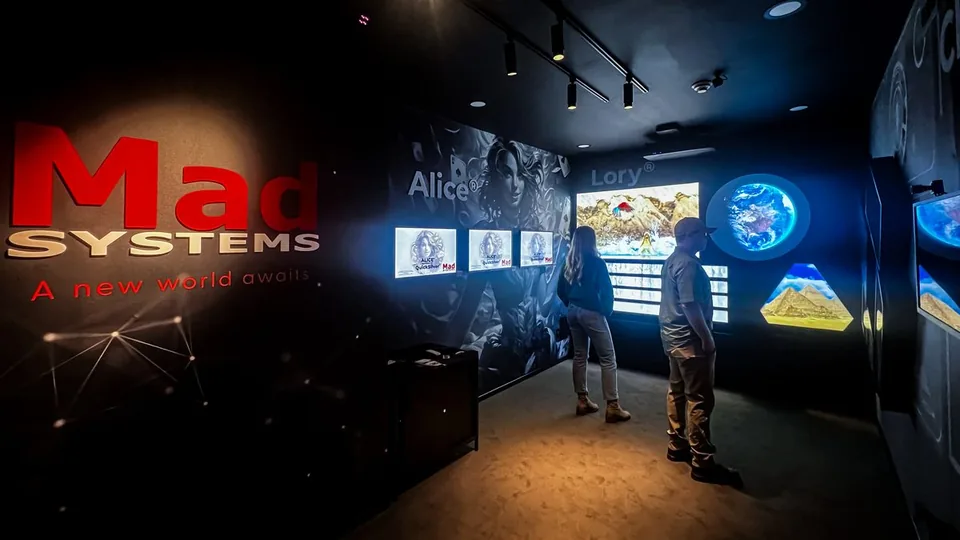
Mad’s Wonderland demonstration room with projection, displays and seating
Mad’s Wonderland demonstration room in an earlier configuration. Arrange a visit to discuss and listen to the Hatter capabilities relevant to your project.

06 / A SCOPE THAT MATCHES THE EVIDENCE

Define what your project needs to prove.

Hatter combines implemented software, working demonstrations and a wider patent-pending architecture. The appropriate next step is to connect a particular requirement to its current capabilities and the evidence needed for the installation.

How Hatter capability and evidence are assessed
StageWhat it establishesWhat the project still checks
Working software and demonstrationsProcessing and authoring foundations, head-tracked loudspeaker listening on Mac, supported headphone and earbud listening, timing and network-audio behavior.The selected build, devices, content and intended operating conditions.
Specified architecture and integrationThe intended relationships between sensing, acoustic location, personalized delivery, guidance, allocation and continuing correction.The required components, completed integration and demonstration of the intended behavior.
Measured installationEvidence about the actual room and listening positions, with its instruments, limits and conditions.Whether the evidence supports each requirement, and how changes will be detected and handled.

The wider research scope includes fleet learning, alternative sensing modalities and specialized acoustic environments. Each extension follows the same discipline: a disclosed design, a working component and a measured installation are different stages, and the evidence must match the claim.

THE CONTINUING LOOP

Keep the engineering active after handover.

Hatter's intended operating loop is continuing: retain the sound requirement, realize it with qualified resources, observe the acoustic result, correct within authority and keep any unresolved result in view.

That is its place within Mad Intelligence. WorldModel supplies relevant context and governance, QuickSilver supplies distributed media and computing, and TeaParty connects control. Hatter delivers and evaluates the acoustic contribution. Imagery, lighting, motion, haptics and other modalities require their own qualified resources and evidence.

LET’S BUILD WHAT COMES NEXT

Bring us the outcome your experience needs.

We will map your brief to the relevant Hatter capabilities, identify the installation requirements and agree on the demonstration or measurement needed for the next decision.

Discuss your Hatter application